Private Longevity Clinic: What to Look for and What to Expect
5 min read
AUTHOR

MEDICALLY REVIEWED BY

Longevity medicine is no longer a fringe concept or an aspiration reserved for science fiction. It is a clinical discipline grounded in decades of research on the biology of aging - and it is increasingly accessible through private longevity clinics that offer the diagnostic depth, therapeutic range, and individualized protocols that standard healthcare was not designed to provide.
But not all longevity clinics are equal. The category spans everything from evidence-based medical practices with rigorous biomarker assessment and clinical-grade interventions to wellness facilities that use longevity language while offering little more than supplements and lifestyle coaching. Knowing what to look for - and what questions to ask - matters before investing in care.
This article explains what a longevity clinic should offer, what separates evidence-based longevity medicine from trend-driven alternatives, and what to evaluate when choosing a provider.
What Is a Longevity Clinic?
A longevity clinic is a clinical practice focused on extending healthspan - the period of life spent in good health - by identifying and addressing the measurable biological drivers of aging before they manifest as disease.
This positions longevity medicine as distinct from two adjacent categories:
- Standard medicine, which is primarily designed to diagnose and treat disease after symptoms appear - a reactive model
- Wellness facilities (spas, health retreats, supplement-focused practices), which address lifestyle but typically lack the clinical depth, diagnostic infrastructure, and physician oversight that differentiate medical care
The scientific basis for longevity medicine rests on decades of research into aging biology. The 2023 update to the hallmarks of aging framework, published in Cell by López-Otín and colleagues, identified 12 measurable biological processes that drive aging: genomic instability, telomere attrition, epigenetic alterations, loss of proteostasis, disabled macroautophagy, deregulated nutrient-sensing, mitochondrial dysfunction, cellular senescence, stem cell exhaustion, altered intercellular communication, chronic inflammation, and dysbiosis. Modern longevity medicine targets these processes - not the downstream diseases they eventually cause.
A landmark Nature commentary by Fontana and colleagues (2014) made the scientific case explicitly: aging is the primary risk factor for most chronic diseases, and targeting aging biology directly is more efficient than treating individual diseases after they emerge.

What Does a Private Longevity Clinic Offer?
A genuine private longevity clinic offers a suite of services that reflects the current state of evidence in longevity medicine - not a menu of popular wellness procedures assembled for commercial appeal. Core components include:
Advanced diagnostics and biological age assessment: Comprehensive biomarker panels that go substantially beyond standard annual labs to assess biological age markers, inflammation (hs-CRP, IL-6), hormonal status (testosterone, DHEA-S, thyroid), metabolic health (insulin resistance, ApoB, Lp(a)), and key micronutrient levels. A longevity clinic that does not begin with deep diagnostics is operating without a map.
Regenerative medicine: Evidence-supported interventions targeting cellular and systemic aging processes. These include therapeutic plasma exchange (https://www.humanauthealth.com/product/therapeutic-plasma-exchange-tpe) - which has a 2025 randomized controlled trial showing a 1.3–2.6 year reduction in biological age in healthy adults over 50 - and stem cell therapies targeting tissue repair and regeneration.
Hormone optimization: Hormonal decline with age is well-documented and measurable. A longevity clinic should offer hormone optimization - including testosterone, DHEA-S, thyroid optimization, and, where indicated, growth hormone assessment - based on lab findings, not symptom reports alone.
IV nutrient therapy: Targeted intravenous repletion of nutrients depleted by aging, metabolic demand, or suboptimal absorption. Clinically useful for NAD+ support, glutathione, B-vitamins, vitamin C, and mineral repletion.
Personalized lifestyle protocols: Evidence-based longevity interventions are not limited to procedures. Sleep optimization, fasting-mimicking diets, and structured exercise prescriptions have demonstrated measurable effects on aging biomarkers. A complete longevity practice integrates these with clinical interventions.
Longitudinal tracking: A single assessment and treatment session is not longevity care. The defining feature of a health optimization clinic is ongoing biomarker reassessment - tracking whether interventions are producing measurable biological change and adjusting protocols accordingly.
What Separates Evidence-Based Longevity Medicine from Wellness Trends
The longevity space has attracted significant commercial interest, which has made distinguishing evidence-based medicine from wellness marketing more important.
Key differentiators:
Evidence hierarchy: Does the clinic cite specific peer-reviewed studies for its interventions, or does it rely on general wellness language? The best longevity clinics are transparent about what is supported by RCT-grade evidence (e.g., therapeutic plasma exchange, hormone optimization for documented deficiency) versus what is promising but earlier-stage.
Measurable outcomes: Does the clinic use validated biological age assessment tools - epigenetic clocks, multi-omic panels - or only subjective self-report? The 2025 Buck Institute trial demonstrated that longevity interventions can produce quantifiable biological age changes. A clinic committed to outcomes should be measuring them.
Clinical oversight: Is care led by licensed physicians with relevant training, or primarily by wellness practitioners? Longevity interventions - particularly those involving hormones, regenerative therapies, and blood-based procedures - require physician-level clinical judgment.
Honest communication about evidence levels: The best longevity practices distinguish clearly between established interventions and those that are emerging. A clinic that presents everything as equally proven should prompt skepticism.
What to Look for in a Private Longevity Clinic
When evaluating a private longevity clinic, ask these questions:
Medical credentials: Who leads clinical care? Are physicians board-certified in relevant specialties (internal medicine, endocrinology, regenerative medicine)?
Diagnostic depth: What specific panels does the clinic run? Do they include biological age markers, comprehensive hormonal assessment, metabolic markers beyond standard cholesterol panels, and inflammatory biomarkers?
Intervention range: Does the clinic offer the full spectrum of evidence-supported longevity interventions - therapeutic plasma exchange, regenerative medicine, hormone optimization, IV therapy - or is it limited to a subset?
Individualization: Is your protocol built from your specific biomarker results, or is every patient given the same "longevity protocol"? True personalization requires interpreting your data, not applying a menu.
Ongoing relationship: Is this a one-time assessment or a longitudinal care relationship? Longevity medicine is an ongoing process; the clinic should offer follow-up biomarker tracking and protocol adjustment over time.
Transparency: Does the clinic communicate clearly about what is well-studied, what is emerging, and what remains uncertain? Intellectual honesty about evidence is a quality signal.

Private Longevity Clinic at Humanaut Health
Humanaut Health is a membership-based private longevity clinic structured around proactive, data-driven care - built to compound over time, not to react when symptoms appear. The practice operates outside traditional insurance to provide the clinical depth and individualization that reimbursement-based models cannot support.
Care is organized through two membership tiers, both anchored in comprehensive biomarker assessment and individualized protocols.
PATH - Ongoing Care ($225/month, billed annually | HSA/FSA eligible)
PATH delivers ongoing longitudinal monitoring and clinical support, including:
- 700+ biomarkers tracked - covering hormones, metabolism, cardiovascular markers, inflammation, and organ function
- 4 quarterly clinical reviews - structured evaluation of your biomarker trends and protocol performance
- 4 hours of dedicated provider time for consultations and follow-up
- Prescription management for hormones, peptides, and evidence-based supplements
PATH is HSA/FSA eligible, making it one of the most cost-accessible entry points into evidence-based longevity medicine.

BOND - Concierge Care (Contact for pricing | Limited availability)
BOND is the full-service private longevity clinic relationship - a dedicated physician, comprehensive testing, and a care plan that evolves with your biology:
- Dedicated functional medicine physician - continuity of care with a single physician who knows your full profile
- Multidisciplinary expert care team - specialists coordinated around your protocol
- Executive physical assessment - thorough baseline evaluation across all major health domains
- All advanced testing and retesting included - no additional lab fees
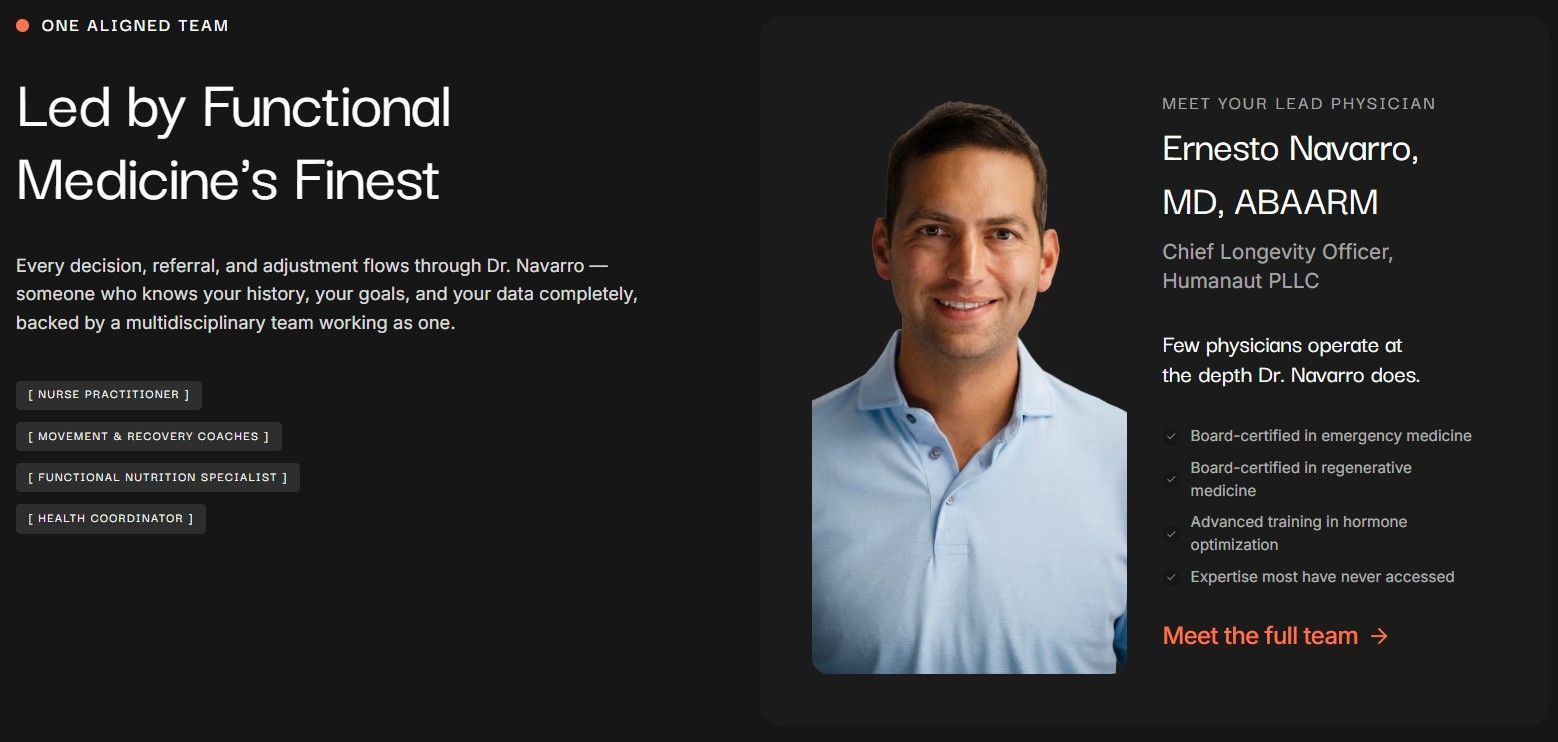
- Monthly consultations with Dr. Navarro - direct, ongoing physician access
- Customized, evolving care plan - adjusted as biomarkers shift and goals develop
- Full coverage of prescriptions, hormones, supplements, and diagnostics
The clinical interventions available through both tiers span the full range of evidence-supported longevity medicine: therapeutic plasma exchange with a 2025 RCT evidence base in biological age reduction, regenerative medicine including stem cell therapies, hormone optimization guided by biomarker data, IV and IM therapy, injury repair, and personalized lifestyle protocols.
Members who begin on PATH can upgrade to BOND while retaining all accumulated biomarker data - the longitudinal record compounds in value over time.
To explore which membership fits your health goals, visit.
Frequently Asked Questions
What is a private longevity clinic?
A private longevity clinic is a physician-led practice focused on extending healthspan by identifying and addressing the measurable biological drivers of aging. It typically offers advanced diagnostics, regenerative interventions, hormone optimization, and personalized protocols - and is distinguished from standard medicine (reactive, disease-focused) and wellness spas (lifestyle-focused without clinical depth).
What services does a longevity clinic offer?
A well-equipped longevity clinic offers advanced biomarker diagnostics, biological age assessment, regenerative therapies (stem cells, therapeutic plasma exchange), hormone optimization, IV nutrient therapy, and evidence-based lifestyle protocols - tracked longitudinally to measure biological outcomes over time.
How is a longevity clinic different from a regular doctor?
Standard medicine is primarily reactive - designed to diagnose and treat disease after it appears. A longevity clinic is proactive - identifying biological dysregulation before it becomes disease and building protocols to address the underlying aging processes. The diagnostic depth, range of interventions, and focus on optimization rather than treatment are the primary distinctions.
Is longevity medicine evidence-based?
Increasingly, yes. The hallmarks of aging framework provides a scientifically validated target list. Interventions such as therapeutic plasma exchange, hormone optimization, and specific lifestyle protocols now have controlled trial-level evidence for measurable biological age effects. The field is evolving rapidly; a quality longevity clinic distinguishes between established and emerging interventions.
What is biological age and can it be measured?
Biological age refers to how old the body's cells and systems are functioning relative to chronological age. It can be measured through validated tools including epigenetic clocks (which analyze DNA methylation patterns), multi-omic biomarker panels, and specific functional assessments. The 2025 Buck Institute trial used multi-omic markers to demonstrate a measurable reduction in biological age in response to therapeutic plasma exchange.
What membership options does Humanaut Health offer?
Humanaut Health offers two tiers. PATH ($225/month, billed annually, HSA/FSA eligible) tracks 700+ biomarkers, includes quarterly clinical reviews, and covers prescription management for hormones and peptides. BOND is the full concierge tier - a dedicated physician, monthly consultations with Dr. Navarro, all testing included, and a fully customized evolving care plan. See full details at humanauthealth.com/memberships.
Key Takeaways
- A private longevity clinic is a physician-led practice targeting the measurable biological drivers of aging - distinct from standard disease-treatment medicine and from wellness facilities
- The scientific basis rests on the 12 hallmarks of aging and a growing body of clinical evidence for targeted interventions
- A quality longevity clinic offers advanced diagnostics, regenerative therapies, hormone optimization, IV nutrient therapy, and longitudinal tracking - built around individual biomarker profiles
- Evidence-based longevity medicine is transparent about what is supported by controlled trial evidence vs. what remains emerging
- When evaluating a health optimization clinic, look for medical credentials, diagnostic depth, intervention range, individualization, ongoing tracking, and honest evidence communication
- At Humanaut Health, longevity care integrates all of these elements within a membership-based concierge model
References
- López-Otín, C., Blasco, M.A., Partridge, L., Serrano, M., Kroemer, G. "Hallmarks of Aging: An Expanding Universe." Cell, 2023; 186(2):243–278. DOI: 10.1016/j.cell.2022.11.001
- Fontana, L., Kennedy, B.K., Longo, V.D., Seals, D., Melov, S. "Medical Research: Treat Ageing." Nature, 2014; 511(7510):405–407. DOI: 10.1038/511405a